
Past Exhibition
KoreanABOUT THE ARTIST
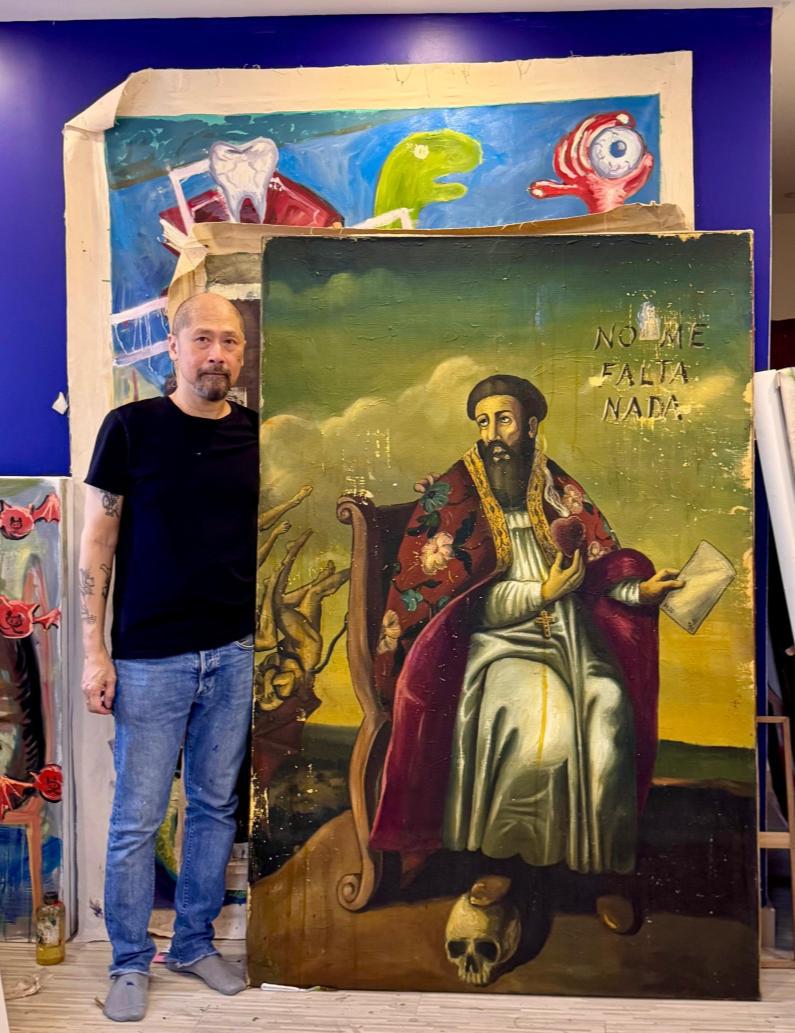
Manuel Ocampo
(b. 1965- Philippines)
The artist has been a vital presence on the international art scene for over two decades now; his works were presented in two of the most important European art events, the Venice Biennale (1993) and Documenta IX (1992). In the early 1990s, he participated in the iconic exhibition “Helter Skelter: L.A. Art in the 1990s” at The Museum of Contemporary Art, Los Angeles (1992).
Public collections include MOCA Museum of Contemporary Art, Los Angeles; MINCARs Museo Nacional Centro de Arte Reina Sofia, Madrid; Fonds National d’Art Contemporain, Paris; Fukuoka Asian Art Museum, Japan; and MUDAM Musée d’Art Moderne Grand-Duc Jean, Luxembourg.


Manuel Ocampo
(b. 1965 Philippines)
The Critic from The Worst Slave Is the One Who Defends the Master
2025
182 × 122 cm (each)
Oil on canvas
This series, The Critic, is a confrontation. It offers a physical and philosophical interrogation of Western abstract art, particularly the sublime and monumental space claimed by High Modernist painting.
The central figure, a duck, appears as a migrant protagonist. Its upright posture and direct gaze invite an uneasy dialogue with the viewer. With its back turned, it presents a circular white opening that becomes the focal point of action and critique. From this point, a continuous stream is released onto fields of color that reference Modernism’s pursuit of the sublime, including its iconic “zips” and spatial divisions.
The variations in the paintings-single bands, paired forms, and shifting widths-function both as homage and critique. They reflect the formal language of a specific historical moment while questioning its authority and seriousness. The duck’s action transforms the abstract idea of “void” into something physical, fluid, and transient, replacing metaphysical silence with a direct, embodied presence.
This gesture reflects the artist’s experience of migration: existing both inside and outside dominant cultural systems. Like the migratory duck, the work moves between worlds, marking space through difference rather than conformity.
Inspired by encounters with non-human agency and chance, the series also embraces accident and disruption as creative forces. Ultimately, The Critic questions who defines artistic space and value, and whether the ideals of modernism can withstand the realities of lived, moving bodies and shifting identities.